
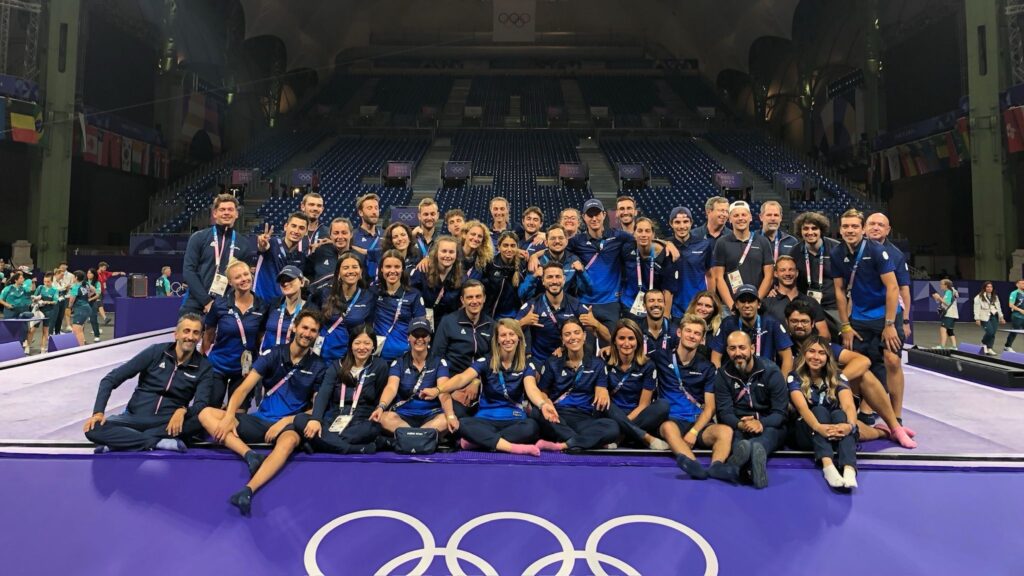
The Paris 2024 Olympic and Paralympic Games concluded successfully, and the synthesis of the post-Games sustainability and legacy report was published in December 2024. Demonstrating its commitment to exemplary practices, Paris 2024 remains a global benchmark for sustainability in event management. The challenge was not in establishing sustainability measures and objectives, but in implementing them on a national scale.
Here is a summary of the report highlighting key data, available here. These insights are, of course, shaped by my personal experience within the heart of the Games’ organization, particularly in the Grand Palais, where my work had its full scope.
ENVIRONMENT
Carbon footprint
The Paris 2024 Olympic and Paralympic Games achieved their ambitious goal of halving carbon emissions, recording a 54.6% reduction in greenhouse gas emissions compared to the average emissions from the London and Rio editions (3.5 MtCO₂e).
- 18% of the carbon footprint comes from operations.
- 29% is linked to the construction of permanent infrastructures, including the Athlete Village, Media Village, and the Olympic Aquatic Centre, which together account for nearly 80% of this impact.
- 53% of the footprint is attributed to transportation related to the Games, particularly spectators.
Circular economy
Paris 2024 stood out for its commitment to the circular economy, prioritizing infrastructure reuse, waste reduction, and material recovery to establish a benchmark in sustainability.
- 95% of the venues were either temporary or existing structures.
- Only one competition venue was built: the Aquatic Centre in Saint-Denis, along with two non-competitive venues: the Athlete Village and the Media Village.
- Temporary venues were optimized through shared space usage, such as at the Pont Alexandre III and Grand Palais sites.
- 78.6% of waste from the operational phase was recycled or avoided.
- 100% of digital equipment was repurposed, with 75% through rental solutions.
- 75% of sports equipment was rented or made available.
Mobility
Sustainable mobility was central to the Games, with 87% of spectators using environmentally friendly transport:
- 62% took public transportation.
- 25% chose active mobility options (cycling, scooters, walking).
Energy, resources and biodiversity
Paris 2024 demonstrated exemplary management of resources and biodiversity:
- 100% of energy needs were covered by electricity from the grid, fully sourced from renewable energy.
- 40% of spectator areas were constructed from wood, sourced entirely from eco-managed forests, with at least 30% from French wood.
- 80% of spectators brought their own reusable water bottles to the sites, with water fountains installed at all venues.
- 1,695 tree protections were put in place to preserve biodiversity.
Sustainable catering
Sustainable catering, prioritizing plant-based options, reducing food waste, encouraging reuse, and limiting single-use plastic, was a key focus. On average, 80% of the products used were of French origin, ensuring local and sustainable food sourcing. The widespread adoption of reusable water bottles and water fountains resulted in a 52% reduction in single-use plastic for beverage distribution.
SOCIAL
Accessibility : a universal priority
Universal accessibility was a fundamental pillar of Paris 2024’s strategy from the candidacy phase, reflected in the promotion of sports for people with disabilities and their social inclusion in the project. To achieve this ambitious goal, Paris 2024 focused on three key areas:
- Ensuring a barrier-free experience for all participants, enabling full engagement in the Games.
- Leaving a lasting material legacy for the host territories that benefits individuals with specific needs.
- Creating an intangible legacy by spreading good practices and embedding the “universal accessibility” mindset in the organization of future events.
Engaging all audiences
Training and Awareness:
Training on environmental and social issues was at the heart of management, involving 100% of the teams in Paris 2024’s commitments and the adoption of eco-friendly practices.
Encouraging Simple Eco-Reflexes:
- Prioritize soft mobility.
- Use reusable water bottles and fountains.
- Sort waste into the correct bins.
- Eat more responsibly.
- Respect the venues and their surroundings.
Leading by Example: Highlighting the successes of the Games:
- Connecting venues to the electrical grid and using 100% renewable energy.
- Reinforced circular economy and low-carbon construction.
- Significant commitments to biodiversity. Communicating these actions through campaigns to inspire more sustainable practices.
Engaged communication
- 100% of competition venues covered by the 2024 Better Together campaign.
- 1,300 panels deployed, including nearly 800 to encourage eco-friendly practices.
- 150 banners marking water fountains and 150 for waste sorting.
- A video broadcast in the stadiums to raise awareness among spectators.
- 22 targeted messages tailored to audiences and spaces for effective communication.
Promoting gender and celebrating diversity
The Paris 2024 Games showcased gender equality and celebrated diversity, while ensuring maximum accessibility and involving the entire French territory in the Olympic and Paralympic journey.
Legacy for the event industry
Three guides have been left as a legacy for the event industry:
- Paris 2024 Guide for Responsible Events
This practical guide offers concrete advice for organizing sustainable events based on best practices developed for Paris 2024.
👉 Consult the guide - Guide for More Sustainable Communication Materials
This document helps organizers design eco-friendly communication materials, reducing their environmental impact throughout their life cycle.
👉 Consult the guide - Climate Coach for Events
An innovative tool that estimates the CO₂ emissions of a sporting event and provides a personalized program with over 100 concrete actions to reduce its carbon footprint.
👉 Discover the tool
GOVERNANCE
The governance of the Paris 2024 Games was distinguished by its commitment to transparent and inclusive management, addressing social, environmental, and economic issues to ensure a sustainable and beneficial legacy for all. Three key areas illustrate this approach:
Sustainable management system:
The implementation of a responsible management system in line with ISO 20121 structured the sustainability of the event, engaging all stakeholders.
Responsible purchasing strategy
Paris 2024 emphasized local sourcing, with 88% of suppliers coming from France, ensuring positive economic returns while reducing carbon emissions from transportation.
Legacy and community
In collaboration with all stakeholders, Paris 2024 aimed to reduce the Games’ climate impact while making sport a driver of social innovation. Paris 2024 committed to organizing events that minimize their environmental impact while contributing to economic and social development, as well as improving quality of life in host communities.
This success is the result of collective and determined mobilization, involving not only the internal teams of Paris 2024 but also a vast ecosystem of partners, engaged suppliers, and associations. Through this close collaboration and shared commitment, the Paris 2024 Games have combined innovation, responsibility, and sustainability, setting a global benchmark for sustainable events. This holistic approach, focused on environmental preservation, social development, and the circular economy, demonstrates the power of sport as a catalyst for positive change, with tangible and lasting impacts for future generations.